Jotting down some great links from a workshop on starting your own lab!
HMS faculty handbook: https://fa.hms.harvard.edu/files/hmsofa/files/fom_handbook_current_issue.dec2020v.pdf
New PI slack: https://newpislack.wordpress.com/
Lab compacts (example of setting lab expectations): http://vosshall.rockefeller.edu/assets/file/Vosshall%20Mentoring%20Compact%202017.pdf
Practical guide to scientific management for postdocs and PIs : https://www.hhmi.org/science-education/programs/making-right-moves
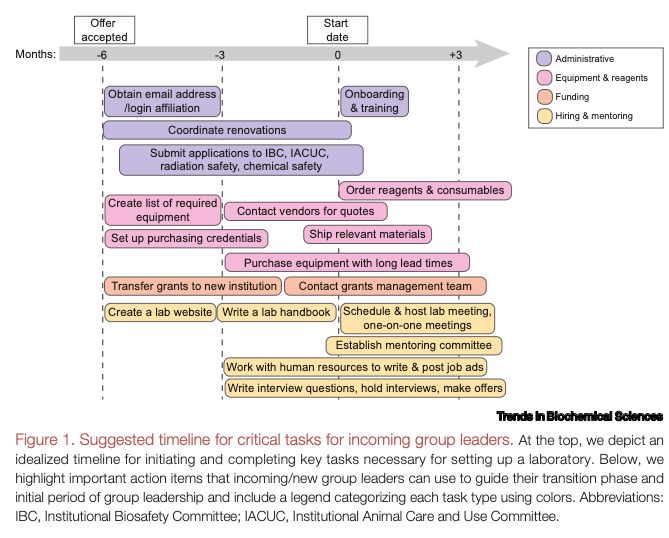
Great article to read on Starting your own lab: McKinley, K.L., Didychuk, A.L., Nicholas, D.A. and Termini, C.M., 2022. The transition phase: preparing to launch a laboratory. Trends in Biochemical Sciences. https://www.sciencedirect.com/science/article/abs/pii/S0968000422001165
Great resources for onboarding a new lab member:
https://elifesciences.org/articles/79627
Examples of onboarding documents (Andreev et al. 2021)
Here we provide a list of example documents that can be used to help build an onboarding package for new lab members. All resources are shared with permission.
- A ‘First-day’ checklist outlining the essential items a new employee should receive and have access to when they arrive in the lab (compiled by the authors). Readers are invited to use and share this template. Link: https://docs.google.com/document/d/1LS8DL-aUL4L2BZeUcg89XYMnPFTzu034JiOmeTGewK4/edit.
- A timeline and milestone document provided by the Sammons Lab (State University of New York at Albany) listing the key events PhD students are expected to complete each year. Link: http://thesammonslab.org/labmanual/grad_student_info/.
- An example of an ‘Individual Development Plan’ for graduate students provided by the Bioscience Department at Stanford University. Link: https://biosciences.stanford.edu/current-students/idp/.
- A lab philosophy shared over Twitter by Dr. Iain Cheeseman (Massachusetts Institute of Technology), outlining his general approach to science: https://twitter.com/iaincheeseman/status/1432654418437095431.
- A detailed lab philosophy document created by Dr. Moin Syed (University of Minnesota) outlining how he manages graduate students and certain aspects of the research process, such as funding and publishing. Link: https://docs.google.com/document/d/1wa067HF3iBv5M0_ao6M1GzPg4mUof_PoVlEAKyIn8Xk. Originally shared in a Twitter thread: https://twitter.com/syeducation/status/1025117254239891463.
- Focused combination of lab policies, philosophy, and best practices published on lab website by Dr. Prachee Avasthi. Link: http://www.avasthilab.org/lab-policies-and-tips/.
Book to read:
At the Helm: Leading Your Laboratory, Second Edition
Subject Area(s):Career Development; Handbooks; Laboratory Techniques
By Kathy Barker, Seattle, Washington
Career development tips:
- Deal with rejection graciously
- Climb from where you fall
- Don’t worry if you paper gets rejected and don’t worry if your paper doesn’t get in a particular journal, if your work is significant enough, it will shine no matter where it is.
- Three key elements for academic career success: publications, grants and a supportive network who will advocate for you
- Use Pubmed to get alerts on latest papers published on your keywords. Keep up to date with literature via Twitter
- Get many people to read over your proposal. Start your first draft as early as possible
- Take baby steps towards your goal
- Respond to emails asap
Questions to ask during the hiring process:
- How long have you known [name] and in what capacity have you worked with [name]?
- Would you say that [name] is a team player?
- Does [name] make the lab a better place to work? If so, how?
- How independent do you think [name] could be? Was [name] comfortable trying new things (optimizing, retesting, etc.), and was [name] motivated to do this?
- What role do you think would best fit [name]?
- Can you comment on [name]’s ability to learn in the lab/on the job?
- Do you feel you can or could rely on [name] to communicate outcomes clearly and honestly? Was [name] accountable for [name]’s time and work?
- Is there anything else that you would like to share about [name] regarding her fit for a research position in our laboratory?
- How flexible is she? Is she willing to work evenings or weekends if needed?
- How motivated is she? Will she read papers? Try to figure out protocols on her own?
- Is she likely to stay 2 years before going to grad school?
- How quickly does she master new tasks?
- She has not handled mice, do you think she would have any problems with mouse surgeries?
- How would you rate her relative to others you have known at her level? Top 5% 10% 25%?
 Shu Lab - Retinal Research Group, UNSW SOVS
Leave a comment